The rain had been falling on Bondi for three straight hours when Sandra Parata finally stopped walking.
She hadn’t planned to end up at the diner on the corner of Campbell Parade — hadn’t planned much of anything that night, if she was being honest. She’d just needed somewhere warm and quiet, somewhere with enough ambient noise that she could sit with her thoughts without feeling entirely alone in them. The kind of place where nobody looks twice at a woman sitting by herself over a cup of tea that went cold twenty minutes ago.
She took the booth by the window. Ordered the tea. Watched the rain.
Sandra was fifty-one years old, recently widowed, and three weeks out from a job she’d held for sixteen years. The redundancy hadn’t been personal — the whole department had gone, restructured away in a single afternoon meeting with a woman from HR she’d never met before. But personal is how it had felt every night since. Personal is what grief always is, even when the world keeps insisting it isn’t.
She wasn’t looking for a sign. She wasn’t really looking for anything. She was just sitting there, hands wrapped around a cold mug, watching raindrops race each other down the glass.
That’s when the door opened.

He came in out of the rain with his hood up, shoulders wet, laughing at something on his phone. He was tall — impossibly tall, the way professional athletes always are in person, built like the world was designed slightly smaller than he needed. He pulled the hood down, shook the water out of his hair, and scanned the room for a seat.
The diner was quiet. A couple near the back. A teenager doing homework at the counter. And Sandra, alone in the window booth with her cold tea.
He took the booth next to hers.
She didn’t recognise him at first. Sandra was not, by any measure, a rugby league woman. She knew the game existed the way she knew cricket existed — as a constant presence in the Australian background, something her late husband Hemi had cared about with a devotion she’d always found equal parts baffling and endearing. Hemi had loved the Roosters. Had watched every game from the same armchair, same can of ginger beer, same running commentary directed at a television that couldn’t hear him.
She found out who the man in the next booth was the same way she found out most things these days — from her phone. She’d glanced over when he ordered, caught the number on his training jacket, and typed it into Google out of idle curiosity.
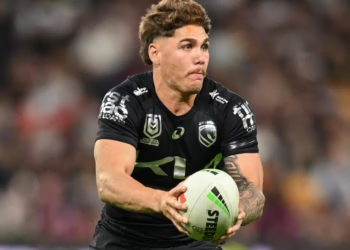
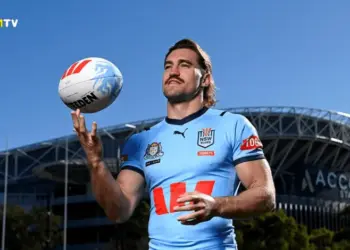
Mark Nawaqanitawase. Sydney Roosters. Centre/Winger.
She stared at the screen for a moment. Then, before she’d fully decided to, she said: “My husband would have lost his mind right now.”
He looked up from his own phone. Not annoyed. Just present, the way some people are — fully in the room with you rather than half somewhere else.
“Sorry?”
“He was a Roosters man,” Sandra said. “Massive fan. You probably hear that all the time.”
“I don’t get tired of it,” he said simply.
She laughed — a short, surprised sound, the kind that comes out before you’ve given it permission. “He passed away eight months ago. I still haven’t figured out what to do with all his jerseys.”
She didn’t know why she said that. She hadn’t planned to say anything at all.
He was quiet for a moment. Not the awkward quiet of someone searching for the nearest exit, but the settled quiet of someone who wasn’t in a rush.
“What was his name?”
“Hemi.”
“Good name.” He nodded slowly. “Maori?”
“His mum’s side. I’m half-Samoan myself, on my father’s. Though you wouldn’t know it — I got all the Irish.”
That made him laugh. A real one.
He introduced himself properly then — Mark, though she already knew — and slid out of his booth and into the seat across from hers with the easy confidence of someone who trusted the world to be friendly until it proved otherwise. He ordered a hot chocolate. She ordered another tea, this time intending to drink it.
They talked for forty minutes.
Not about rugby league, mostly. About Hemi — who he’d been, how he’d watched football like it was a religious experience, how he’d made Sandra sit through the 2013 grand final even though she’d had a work deadline the next morning, how she’d ended up crying at the end not because of the game but because of the look on his face when the siren went. About what it felt like to lose someone slowly versus all at once. About the particular cruelty of redundancy — not the money, she said, though the money was frightening, but the identity of it, the sudden absence of a place that expected you to show up.
Mark listened. Not with the performance of listening — the tilted head, the strategic nods — but actually listened, the kind that makes you feel the weight of what you’re saying being received somewhere.
He told her about his own father, who had driven him to every training session in a car with a broken heater for two years because they couldn’t afford a new one. About the first time he’d pulled on a Wallabies jersey and thought about all the mornings in that freezing car. About being Fijian and Italian and Australian all at once, and how that used to feel like a complication and now felt like a gift.
He said: “The in-between is always the hardest part. But the in-between is also where you find out what you’re actually made of.”
Sandra wrote it down on the back of a receipt. She didn’t usually write things down.
When he left, he shook her hand. Told her to keep the jerseys.
“Wear one to a game sometime,” he said. “He’d have liked that.”
She watched him walk out into the rain, hood back up, already on his phone again. The diner went back to quiet. The couple near the back asked for their bill. The teenager packed up her homework.
Sandra sat for another few minutes. Then she picked up her phone and called her daughter — the first time she’d called anyone in three weeks without it being an emergency.
“I’m okay,” she said, when her daughter answered. “I just wanted to say that. I think I’m going to be okay.”
Outside, the rain had softened to something lighter. Almost nothing. The kind of rain you only notice once it stops.
She did go to a game, eventually. Round 14, a Friday night, the Roosters against Parramatta under the lights at Allianz Stadium. She wore Hemi’s jersey — a little big across the shoulders, the way his things always were — and she stood up when everyone else stood up and yelled when everyone else yelled, and she did not cry until the bus home, alone, in the dark, which she decided was exactly the right time and place for it.
Mark Nawaqanitawase scored two tries that night.
She didn’t need to look up the name anymore.