Will Galvin fit into the seven jersey without issue in 2026?
The obsession with forcing young playmakers into rigid positional boxes has become one of the laziest habits in rugby league discussion.
Every generation recycles the same arguments, dressed up as insight but rarely grounded in what is actually happening on the field. If a player runs well, he must be a six. If he has size, he must eventually be a lock. If he is young, he must be moved somewhere else until he supposedly learns how to play the position he is already playing.
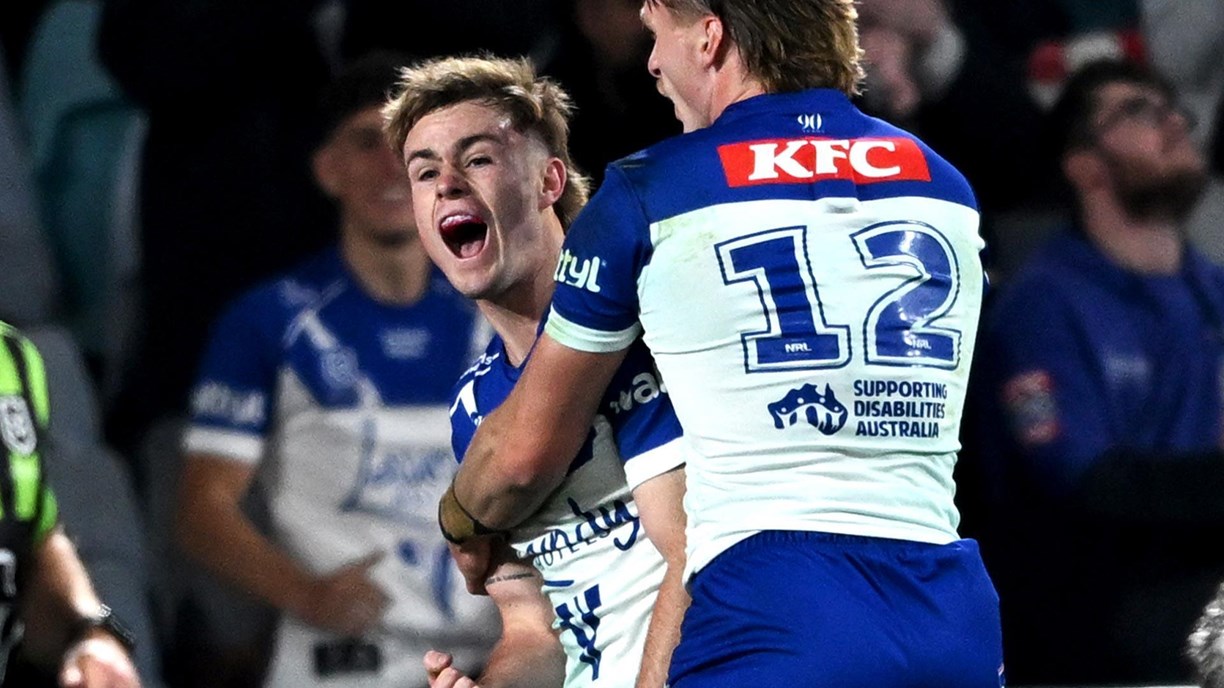
This is the framework through which Lachlan Galvin is currently being judged, and it explains why the conversation around him feels detached from reality.
Galvin is twenty years old and nowhere near finished. That matters. No serious observer would deny that his physical profile, competitiveness and skill could one day see him succeed in multiple roles depending on how his body and the team around him evolve.
That possibility exists for most elite young playmakers. What is strange is the way those future hypotheticals are being used to dismiss what is already happening.
Right now, Galvin plays the game like a halfback.
He does not hover on an edge waiting for moments. He does not play in pockets. He inserts himself into the middle of the contest, demands early involvement, works both sides of the ruck and accepts responsibility when sets become messy.
He shapes play before defences settle rather than reacting once space appears. These behaviours are instinctive. They appear early in players who are wired to organise rather than float.
The six versus seven debate has always struggled with this distinction, and history shows it regularly gets it wrong.
The clearest example remains Johnathan Thurston. Thurston was let go by the Bulldogs in part because the club already had Braith Anasta entrenched as the six. He was never earmarked as a halfback and was never viewed as a replacement for the club’s great organisers. He had all the tools to be a high-end five eighth and that is largely how he was perceived.
His first season at halfback took North Queensland to their first ever grand final. Across his career, he shifted seamlessly between halfback and five eighth at the highest level, including State of Origin, to accommodate players like Darren Lockyer or Cooper Cronk.
Not once, on the biggest stages against the best of his generation, was there serious noise about Thurston not being a halfback. He will be immortalised as one.
That context matters when evaluating Galvin.
It also matters when considering how opinions around him are framed. When Phil Gould described Galvin as one of the greatest teenage players he had ever seen, the reaction from parts of the media was not curiosity or examination but ridicule. The statement became something to mock rather than explore. Attention shifted away from what Gould was identifying on the field and toward treating the comment itself as exaggeration or agenda.
That response says more about the ecosystem than the player.
Modern rugby league commentary is built on opinion and narrative. Former players and analysts are paid to assess, predict and frame discussion, often well before players are finished products. That does not make their views dishonest, but it does mean they are not definitive.
Rugby league history repeatedly shows that expert consensus is not immune from being overtaken by what unfolds on the field.
Galvin’s game should be judged the same way every genuine halfback eventually is. By how often he touches the ball. By where he positions himself when the game is unsettled. By whether teammates look to him for direction. By how willingly he carries responsibility when momentum turns.
On those measures, the picture is already clear.
The Bulldogs have not had a halfback occupy the role this organically since Trent Hodkinson. Not because Galvin is a finished product and not because comparisons guarantee outcomes, but because the manner in which he plays the position is recognisable. It is central rather than peripheral. It is constant rather than selective. It is driven by ownership rather than instruction.
The fixation on what Galvin might eventually become has distracted from a simpler truth. Elite halfbacks are defined less by labels than by behaviour. Vision, repeated involvement, decision making under pressure, and a willingness to take control when the game is uncomfortable.
Measured against those standards, Galvin is not lacking anything.
He has demonstrated all the traits required of an elite half. If he keeps improving as Gould and the Bulldogs expect, we could be witnessing the emergence of a once in a generation player or at the very least, a representative star of the future.
Rugby league has always been honest about one thing. You learn what a player is by watching where he goes when the game needs someone to take charge.