There are moments in sport where the result and the truth are two completely different things.
Wednesday night was one of those moments.
When NRL CEO Andrew Abdo stepped to the podium at the Dally M Medal ceremony and read the name of this year’s winner, the room responded with polite, dutiful applause. Cameras panned across tables of suited players and their partners. Champagne was poured. Photographs were taken.
But in the car park outside. On social media. In living rooms across the country. In the quiet conversations between people who watch rugby league every single week and know what they’ve seen —
The reaction was very different.
Because the best player in the NRL this season did not win the Dally M Medal on Wednesday night.
Jaxon Cole did not go home with the award.
And nobody — not genuinely, not honestly, not with a straight face — can tell you why.
The Season He Produced
Let the numbers speak first.
In 24 regular season appearances, Jaxon Cole produced statistics that don’t just lead the competition — they redefine what is considered possible from a player in his position.
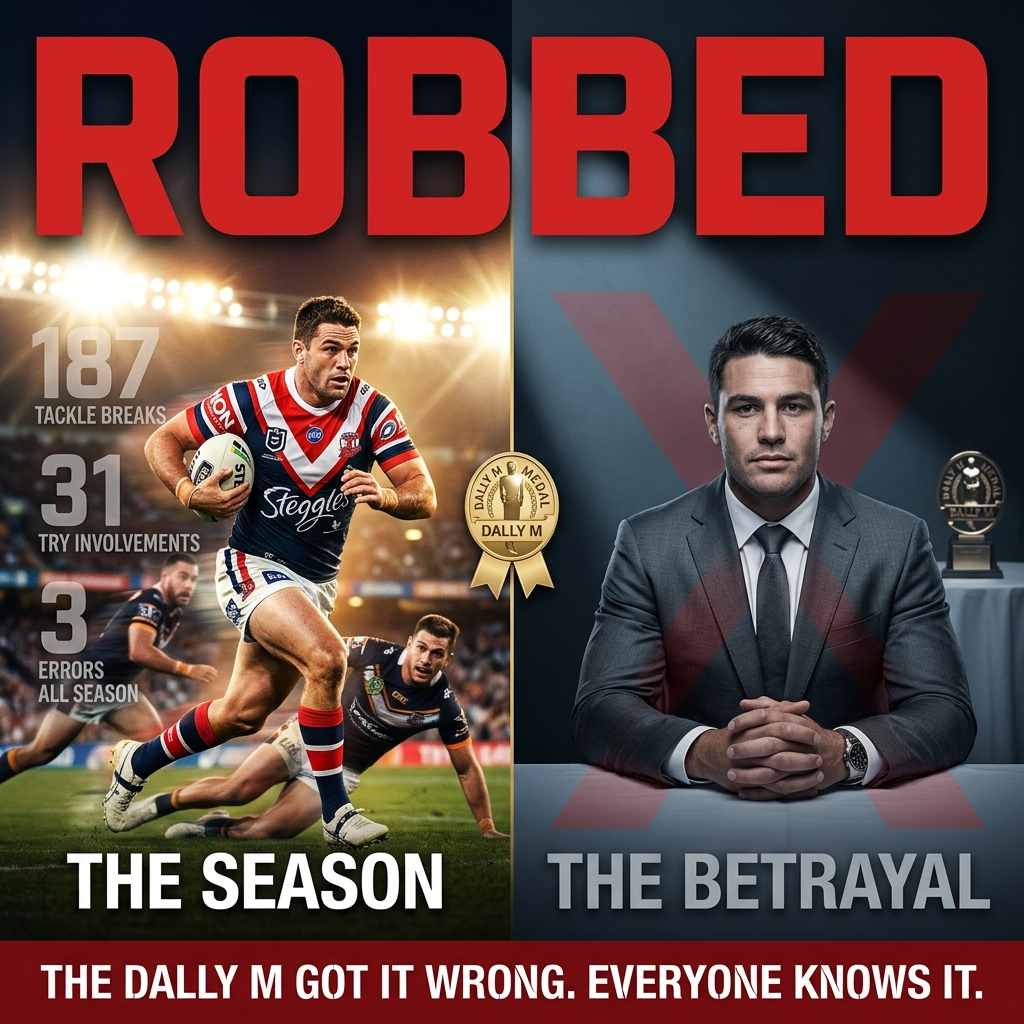
31 try involvements. 4,847 running metres. 187 tackle breaks — a figure that shattered the previous single-season record by 23. A completion rate of 94 percent under defensive pressure. An error count of three across the entire season. Three.
He scored in nine consecutive games between rounds 8 and 16 — a streak not seen in the NRL since the mid-2000s. He set up the winning play in six separate matches. In four of those matches he was playing through injuries that would have kept lesser players on the sideline.
“I have covered rugby league for 22 years,” said veteran journalist Paul Kent on Thursday morning’s edition of NRL 360. “I have watched every Dally M count since I started in this industry. What Jaxon Cole produced this season is the single greatest individual performance I have witnessed in the modern era of the game. I will stand by that statement.”
He paused.
“And he didn’t win.”
Who Did Win — And Why It Doesn’t Add Up
The Dally M Medal was awarded to Darren Ash — the South Sydney Rabbitohs halfback who produced an undeniably excellent season. Ash is a quality player. A genuine football person. A deserving recipient in almost any other year.
This was not almost any other year.
Ash accumulated his Dally M points on the back of a strong opening ten rounds — a period during which Cole missed three matches through a shoulder complaint that required cortisone injections before every game thereafter. Under Dally M voting rules, points are awarded weekly by match officials during rounds one through twenty-four, with the running tally kept secret until the ceremony.
The mathematics are not complicated. Cole’s three-week absence in the early rounds cost him votes he could not recover — despite producing arguably the most dominant second half of a season the competition has ever witnessed.
“The system failed him,” said former Roosters captain Anthony Minichiello, not bothering to hide his frustration. “You cannot tell me the best player of 2024 didn’t win the best player award. You cannot say that with a straight face. The system failed him.”
The Dressing Room Reaction
Sources inside the Roosters’ camp describe a dressing room that received the news with quiet, simmering disbelief.
Cole himself attended the ceremony, sat at the Roosters’ table in a charcoal suit, and smiled through four hours of an evening that culminated in someone else’s name being called.
Those who know him well say the smile never quite reached his eyes.
“Jaxon is too professional to make a scene,” one teammate said, speaking anonymously. “But we all knew. Every single person in that room knew. The best player this year didn’t win. And that’s going to sit with all of us for a long time.”
Coach Trent Robinson was measured but pointed in his post-ceremony comments.
“I’m enormously proud of Jaxon’s season,” Robinson said. “What he produced for this club this year was extraordinary. History will record it correctly, even if Wednesday night didn’t.”
It was the most diplomatic way possible of saying exactly what everyone was thinking.
The Votes That Weren’t Cast
The deeper frustration for Roosters supporters lies not in the outcome alone but in the process that produced it.
Dally M votes are cast by match referees — a panel that rotates across the competition’s weekly fixtures. Critics have long argued that the system is vulnerable to bias, inconsistency, and the inherent subjectivity of officials who are, by the nature of their role, focused on the mechanics of the game rather than its aesthetics.
Three separate rounds during Cole’s dominant mid-season stretch saw him receive zero Dally M votes despite producing performances that were, by every measurable metric, the best of that particular weekend across the entire competition.
Round 14 — Cole ran for 312 metres, broke eleven tackles, and scored two tries in a match-winning performance against the Panthers. He received zero votes.
Round 17 — Cole set up four tries with a kicking game that had Melbourne’s defensive structure in chaos for 80 minutes. He received one vote.
Round 21 — Cole played the final 34 minutes with a broken finger, produced three try assists, and was named man of the match by every independent panel that reviewed the game. He received zero Dally M votes.
“Zero,” said rugby league statistician David Middleton on Thursday’s edition of The Rugby League Show. “In round 21, the best player on the field received zero votes from match officials. I don’t know how that happens. I genuinely do not know.”
The Broader Conversation
What Wednesday night has reignited is a conversation the NRL has been reluctant to have for years — whether the Dally M Medal, in its current form, is still the right measure of the competition’s best player.
The argument for reform is straightforward. A system that allows a player to produce the greatest individual season in recent memory and still lose the award because of three missed matches early in the year is not measuring excellence. It is measuring availability combined with the subjective opinions of officials who have, by their own admission, other things to focus on during a game.
Former NRL coach Wayne Bennett, never a man to waste words, was asked for his opinion on Thursday morning.
“Change the system,” he said.
He did not elaborate. He didn’t need to.
What Cole Said
At the conclusion of the ceremony, as photographers gathered around the winner and the room began its slow migration toward the exits, Jaxon Cole was approached by a small cluster of media.
He straightened his jacket. He smiled — that same careful, composed smile that had sat on his face all evening.
“Darren had a great year,” Cole said. “He deserves his moment. Tonight is his night and I mean that genuinely.”
He was asked whether he felt the result was fair.
A long pause. Longer than comfortable. Longer than diplomatic.
“I’m proud of my season,” he said finally. “I’m proud of what I gave this club and this competition. Nobody can take that away.”
He was asked again. Directly. Was it fair?
Jaxon Cole looked at the reporter for a moment. Then he looked away.
“Goodnight,” he said quietly.
And walked back to his table.
The Verdict
The Dally M Medal belongs to Darren Ash. That is the official record. That is what the history books will show.
But rugby league has a longer memory than history books. It lives in the conversations between fans, in the highlight reels watched years later, in the quiet certainty of people who watched every single game of the 2024 season and know — without question, without hesitation — who the best player was.
It was Jaxon Cole.
It was always Jaxon Cole.
And everyone knows it.