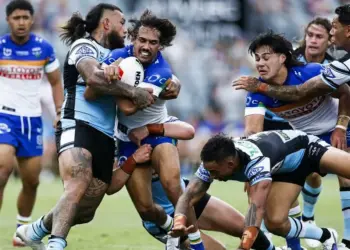
In the NRL, premierships aren’t won solely by star power. They’re built on depth, durability, and the ability to survive the long grind of a season. For the Sydney Roosters, a club synonymous with elite standards and sustained success, one position stands above the rest as absolutely non-negotiable when it comes to depth: hooker.
Why hooker matters more than ever in the modern NRL
The hooker role has evolved into one of the most demanding and influential positions in the game. Today’s dummy-half is not just a passer from the ruck — they are a defensive organiser, tempo controller, secondary playmaker, and often a 80-minute engine.
Fast service out of dummy-half dictates ruck speed. Ruck speed dictates momentum. And momentum dictates results.

When a team loses control of the middle, everything downstream suffers: the halves have less time, edge forwards run poorer lines, and defensive fatigue sets in. Few teams understand this better than the Roosters, whose best seasons have been built on dominating the ruck through intelligence and intensity rather than just size.
The Roosters’ system relies on ruck control
Historically, the Roosters have thrived when their hooker has been able to:
- Generate quick play-the-balls
- Pick the right moments to run
- Defend relentlessly around the middle
- Organise tired forwards late in sets
Their forward pack is designed to work in tandem with a sharp dummy-half. Without that connection, even elite forwards can look ordinary.
When hooker service slows, the Roosters’ structured attack becomes predictable. Defensive lines set earlier. Pressure shifts to the halves. Territory is lost. It’s a domino effect — and it happens quickly.
Injuries and Origin make depth essential
The NRL season is unforgiving. Injuries are inevitable. Add State of Origin, suspensions, and workload management into the mix, and relying on a single elite hooker becomes a gamble.
For a club with premiership ambitions, the question isn’t if the first-choice hooker will miss games — it’s how the team copes when it happens.
Teams without genuine depth at dummy-half often resort to reshuffling:
- Lock forwards filling in
- Playmakers over-handling
- Defensive workloads spiking
These fixes rarely hold up against top-four opposition. The Roosters, who expect to be competing deep into September, can’t afford patchwork solutions in such a critical role.
Finals football exposes weakness at hooker
September footy is faster, tighter, and more brutal through the middle. Referees allow more contact. Fatigue becomes a weapon. The hooker is at the centre of all of it.
In finals, the smallest drop in service quality is magnified. A half-second slower pass can kill a set. A missed tackle around the ruck can swing momentum. A tired dummy-half becomes a target.
This is where depth separates contenders from pretenders. The Roosters’ rivals know it — and they will exploit any weakness at hooker without hesitation.
Why other positions don’t carry the same risk
The Roosters have proven they can cover injuries in other areas:
- Edge forwards can be rotated
- Centres and wingers can be reshuffled
- Even halves can be supported by system and structure
Hooker is different. There is no hiding place. Every play runs through them. If the replacement isn’t NRL-ready, the entire system suffers.
Depth at hooker protects premiership windows
The Roosters are a club that plans in windows — not seasons. Their roster construction reflects long-term ambition. Losing depth at hooker doesn’t just risk individual matches; it risks entire campaigns.
Strong depth allows:
- Rotation without drop-off
- Tactical flexibility
- Injury insurance
- Sustained performance across 27 rounds
For a club that measures success in trophies, not ladder positions, that matters.
Final word
If there is one position the Sydney Roosters cannot afford to gamble on, it’s hooker.
Depth here isn’t a luxury. It’s structural integrity. Lose it, and the Roosters lose control of the ruck — and when that happens, even the strongest roster can unravel.
In the NRL, premierships are built in the middle.
And for the Roosters, it all starts at dummy-half.