
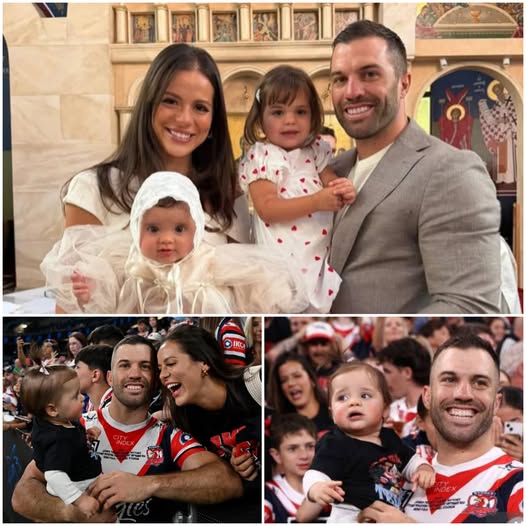
After one of the most physically punishing performances of his career, the Roosters fullback was reduced to tears — not by the pain of the game, but by the love of a three-year-old who didn’t know the score.
He had taken hit after hit. He had carried, covered, tackled and gritted his way through eighty minutes of some of the most unforgiving rugby league you’ll see this season. And when the final whistle sounded, James Tedesco looked like a man who had left every single thing he had out on that field.
Then a small figure in a pink dress came running across the grass — arms outstretched, completely unaware that her dad had just played one of the hardest games of his life — and James Tedesco, one of the toughest players in the NRL, broke down completely.
He dropped to one knee. He wrapped her up. And the tears came.
It was a moment so raw and unguarded that even hardened reporters on the sideline were quietly looking away, feeling as though they were witnessing something that didn’t belong to them. It belonged only to a father and his daughter, in the middle of a football field, long after the crowd had stopped chanting.
A Game That Tested Everything He Had
To understand what made that moment so overwhelming, you have to understand what came before it. This was not a comfortable win. This was not a game where Tedesco cruised. From the opening set, he was a marked man — opposition defenders targeting him with intent, knowing that unsettling Australia’s best fullback early can destabilise an entire team’s confidence.
He absorbed it all. Every swinging arm. Every shoulder to the ribs. Every moment where the professional thing — the team thing — meant taking the contact rather than going around it. He finished the game having covered more ground than any other player on the field, with bruises that would announce themselves properly the following morning.
The numbers tell part of the story. They always do, in rugby league. But numbers can’t tell you what it costs a body — and a mind — to perform at that level, week after week, season after season, carrying the expectations of a club, a fanbase, and a national jersey.
Then She Came Running
His daughter was three steps onto the field before the security staff even registered what was happening. By the time anyone could have stopped her, she was already in his arms.
Tedesco caught her mid-stride, swinging her up and pressing his face into her shoulder. And that was when it happened — the shoulders started moving, the head dipped low, and the man who had spent eighty minutes refusing to show weakness in front of 40,000 people finally let go.
“She just ran straight at me. Didn’t care about anything. Just — Dad.”
James Tedesco, post-match
Those who were close enough to hear him say those words post-match described a man still processing the enormity of the emotion. Not the game — the game was over. But the collision of those two worlds: the brutal, demanding, unforgiving world of elite professional sport, and the completely unconditional, uncomplicated world of a three-year-old who just wanted her dad.
Why This Moment Matters
In the age of social media performance and carefully curated athlete images, there is something almost startling about a moment this real. No PR team planned it. No camera crew was positioned for it. It just happened — messy and honest and human in the way that only unscripted moments can be.
Rugby league, perhaps more than any other sport, asks its players to project invulnerability. The culture of the game rewards toughness and punishes anything that resembles softness. Players are expected to take punishing contact and get up. To absorb pressure and smile. To be relentless, week after week, without complaint.
And then a little girl in a pink dress dismantles all of that in about four seconds.
Because she doesn’t know about the game’s score. She doesn’t know about the dropped ball in the 62nd minute or the try-line tackle that left him winded. She doesn’t read the match reports or track the carry metres. She just knows — with absolute certainty — that her dad is the best thing in the world, and she hasn’t seen him all day, and now he’s here.
The Price of Excellence
Elite athletes at Tedesco’s level operate in a kind of sustained sacrifice that is rarely acknowledged publicly. The early mornings, the strict diets, the absences from family events that fall on game weekends. The constant management of the body as an instrument — ice baths, physio, recovery protocols, the quiet dread of every heavy contact wondering if this is the one that ends the season.
Families absorb so much of that cost. Spouses who understand, children who don’t quite yet. The small daughter who knows that sometimes Dad isn’t home for dinner, and that sometimes he comes back from work with bruises on his arms and tape on his fingers, and that none of that matters because when he’s here, he’s really here.
That’s what broke him. Not the pain of the game — elite athletes learn to live with that. It was the relief of being somewhere the game couldn’t follow. Of being held by someone for whom none of it mattered. Of being, for just a moment, not the best fullback in the NRL but simply — irreplaceably — Dad.
What the Cameras Caught
The vision circulated quickly. Within an hour it had been shared thousands of times — not because people love James Tedesco the footballer, though many do, but because people recognised something universal in it.
We have all, in our own way, had versions of that moment. The day at work that hollowed you out. The week that asked too much. The moment when the professional armour finally comes off because someone who loves you walked in and without saying a single word, gave you permission to feel it.
Children do this without knowing they’re doing it. They don’t offer comfort in the way adults do — with words, with careful gestures, with the awareness of what the other person needs. They just run at you. Arms wide. Completely sure that you’ll catch them. And in catching them, somehow, you catch yourself too.
The Scoreboard Was Always Secondary
The Roosters won. That will matter, in the days ahead — in the analysis and the ladder positions and the building of whatever this season becomes. Tedesco will recover, train, and do it all again next week.
But the image that will stay — that already has stayed, for the thousands who shared it — isn’t from the game. It’s from after the game. A man on one knee on a grass field at night, holding his daughter, head bowed, shoulders shaking. Everything spent. Everything replenished.
The scoreboard was always secondary. It just took a three-year-old to prove it.