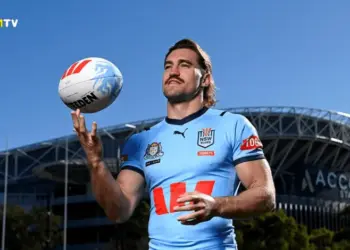
Super League millions. Rugby union. Mary Fowler in Manchester. The entire world is calling. And Nathan Cleary keeps saying the same thing — it’s hard to imagine being anywhere else. That loyalty has a price. And it’s bigger than most people realise.
There is a number attached to Nathan Cleary’s next contract that nobody in Australian rugby league wants to say out loud. Two million dollars per season. That is the figure — floated openly after the new broadcast deal — that would make Cleary the highest-paid player in the history of the NRL if Penrith matches what the market will offer. And it still might not be the most money on the table.
Hull FC reportedly tabled £1 million per season in Super League pounds. Rugby union — a code he has openly said he would “entertain” — would match or exceed that. PNG, Perth Bears, every NRL club with cap space and ambition has Cleary at the top of their wishlist from November 1. The world, in every sense, is at his feet.
And yet. Here is what Nathan Cleary said when asked to imagine wearing a different jersey for the first time in his 197-game NRL career:

That is not a line from a man who is leaving. That is not even a line from a man who is seriously entertaining leaving. That is the language of someone whose identity is so intertwined with a football club that separating the two feels, at a purely human level, almost impossible to process.
And that — not the premierships, not the Dally M Medals, not the four titles — is what makes Nathan Cleary’s loyalty story one of the most extraordinary in modern sport.
Before we discuss what Cleary might sacrifice in his next deal, it is worth establishing what he has already sacrificed. Because the 2026 contract conversation does not happen in isolation — it is the third chapter of a loyalty story that has consistently cost him money.
His partner, women’s soccer player Mary Fowler, lives in England, and Cleary would well entertain the idea of a switch to Super League or rugby union. This is the dimension of the Cleary contract story that has nothing to do with football and everything to do with being a 28-year-old man who has spent his entire adult life inside the walls of Penrith Panthers.
Fowler plays for Manchester City. She is one of the best footballers in the world. Her career trajectory — another decade at the highest level of women’s football, potentially in the NWSL in America, potentially back in Australia — is not something Cleary can predict or plan around with certainty. But if he signs a three or four-year deal in Penrith, he is making a choice about geography that goes well beyond rugby league.
The most romantic version of this story is Cleary staying at Penrith, Fowler eventually moving back to Australia, and the two building a life together in Sydney’s west while he plays out the greatest halfback career the NRL has ever seen. The most complicated version involves a long-distance relationship, the pull of a European lifestyle, and the question every elite athlete eventually faces: when does what I want from life outside football start to matter as much as the football?
“I’m open to it, I’m open to different possibilities whereas maybe in the past I’ve been locked into things. I’m quite open — that thing about having no regrets drives me.”
— Nathan Cleary, February 2026
If Cleary signs with Penrith — and the balance of probability, based on everything he has said publicly, still points in that direction — he will be making a choice that has no equivalent in modern Australian sport. To turn down Super League millions, rugby union’s World Cup carrot, and the freedom of the open market, at the peak of your powers, for the club where you grew up. Not because the money isn’t real. Not because the offers aren’t genuine. But because some things matter more than money.
Andrew Johns played his entire career at Newcastle and is rightly celebrated as one of the greatest one-club men in the game’s history. Johnathan Thurston did the same at the Cowboys. Cameron Smith at the Storm. These are the names that define loyalty in rugby league — players who had the talent to name their price anywhere and chose, instead, to build something singular and permanent at one club.
Cleary is 28. He is better right now than any of those players were at 28. The dynasty he is building at Penrith — four premierships before turning 30 — has no parallel in the NRL era. If he stays and wins one or two more, the Immortality conversation becomes inevitable and irreversible.
That is what the ultimate sacrifice buys. Not just loyalty — legacy.
Nathan Cleary has not yet signed. The market opens November 1. Everything is still in play — the Super League pounds, the rugby union World Cup, the Perth marquee dream, the PNG history-making moment. All of it is real. All of it is on the table. And yet — “it’s pretty hard to imagine being somewhere else.” Those nine words, spoken quietly in March, may turn out to be the most consequential sentence in the 2026 NRL season. Because when Nathan Cleary says something is hard to imagine, history suggests he means it.