
A coach pulls his winger aside mid-game. The winger scores a try. The Raiders win by two. And in those few seconds on the boundary line at Optus Stadium, you see everything that makes this Canberra team worth watching.
Savelio Tamale dropped two high balls, fumbled a pass, and nearly stopped short of the tryline in Perth on Saturday. His coach pulled him aside anyway — not to criticise, but to remind him of something more important.
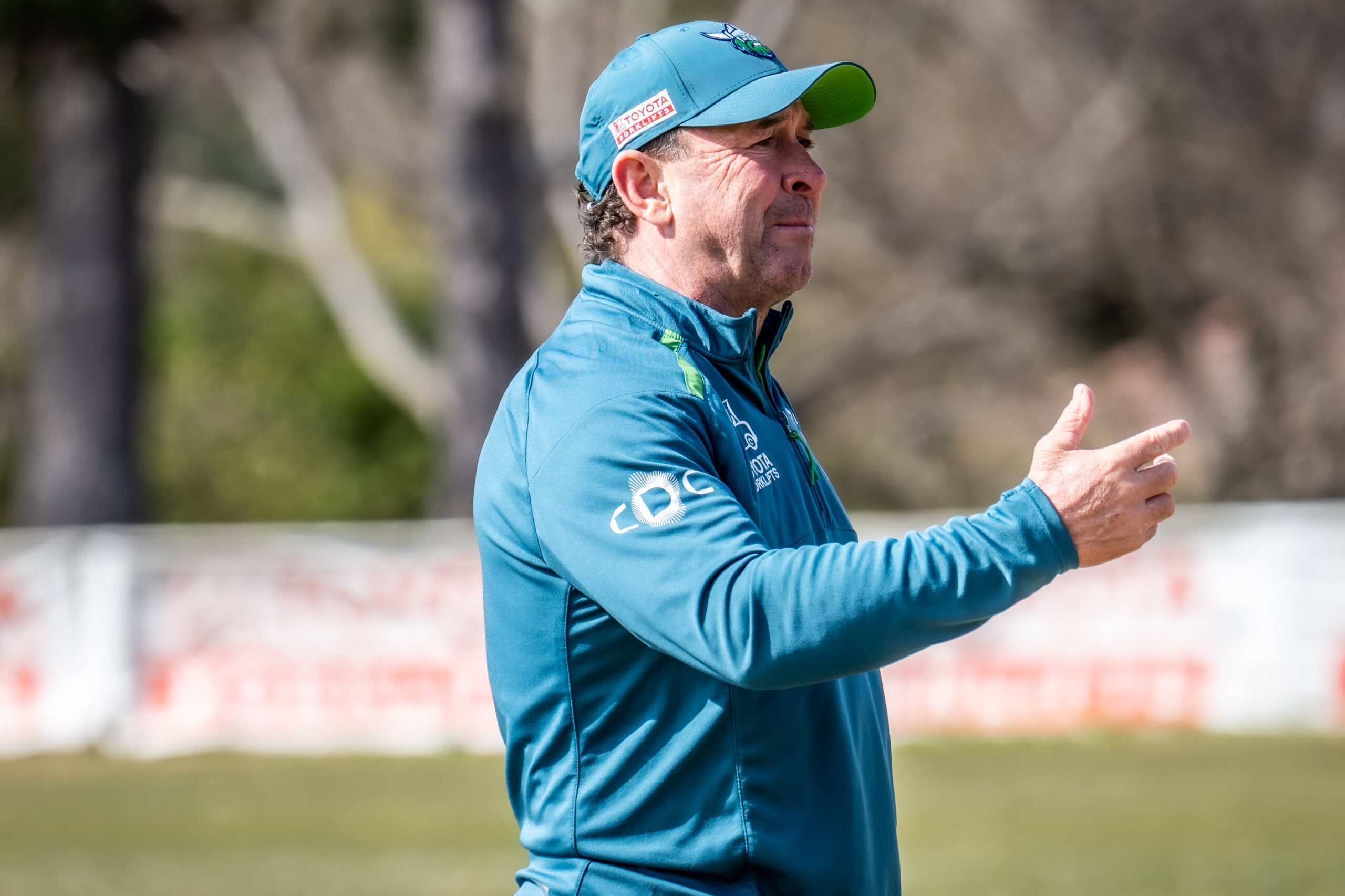
It was the kind of moment that cameras catch but commentators rarely slow down long enough to fully explain. During the first half of Saturday’s pulsating 36-34 win over the South Sydney Rabbitohs at Optus Stadium in Perth, with his winger struggling through a case of the fumbles that had the Green Machine faithful watching through their fingers, Canberra Raiders coach Ricky Stuart pulled Savelio Tamale to the boundary line.
He wasn’t pulling him for a spray. He wasn’t yanking him out of the game. He was doing something that, in the heat of a contest that the Raiders desperately needed to win to snap a four-game losing streak, might be the most important thing a coach can do for a young player who is carrying confidence like a man trying to hold water in cupped hands.
He was telling him to believe in himself.
“Believe in your ability,” was the essence of what Stuart said to Tamale in those few seconds on the boundary at one of the world’s great sporting venues. And whatever was in those words — whatever combination of faith and challenge and warmth a coach of Ricky Stuart’s experience knows to deploy in exactly that moment — it worked. Tamale went back onto the field and helped the Raiders win a game that, at multiple points in the afternoon, looked beyond them.
It is a small story inside a big one. But it is also, if you look at it carefully, the whole story.
Who Savelio Tamale is — and why this matters
To understand why Stuart pulled Tamale aside and urged him to believe in his ability, you need to understand what Tamale is capable of when he is playing with confidence — and how recently that confidence was in full, extraordinary flower.
Last season, despite missing nine games through injury, the 21-year-old winger finished second in the count for the Raiders’ player of the year award — the Meninga Medal. Second. While missing nearly half the season. The consensus among those inside the Canberra football department is that Tamale would have won the medal outright — and won it convincingly — had he stayed healthy. He is that good. He has that much natural talent. When he is running with the ball and running with belief, he is one of the most dangerous wingers in the NRL.
In 2026, though, something has shifted. The confidence that made him nearly win the Raiders’ best-and-fairest despite missing nine games has not transferred cleanly into the new season. He is, in Stuart’s own assessment, “down on confidence.” And a winger without confidence is a winger at war with himself at exactly the moment the game demands he trust his instincts.
“He might have won last year’s Meninga Medal by the length of the Thoroughbred Park straight if he hadn’t missed half a season through injury.”
— Canberra Times, reporting on Tamale’s 2025 season
The moment that crystallised everything
What happened in the 28th minute of Saturday’s game at Optus Stadium was simultaneously brilliant and baffling — and perfectly illustrative of what it looks like when a supremely talented player is fighting their own head.
Tamale swooped on a Rabbitohs fumble and launched into a 50-metre sprint for the tryline. Nobody near him. The line ahead. A moment that, for a winger in the form of his life, ends one way: four points.
Tamale scoops the ball from a Rabbitohs fumble and sprints 50 metres up the touchline. He has the pace. He has the space. He has everything. But one metre from the tryline — with the try at his mercy — he inexplicably pulls up short instead of diving over. South Sydney five-eighth Cody Walker arrives and lays a heavy tackle. Tamale is just able to scramble the ball down. Try awarded. But it should have been comfortable. Instead it is a near-disaster that tells you everything about where his head is right now.
He also dropped two high balls in the first half and fumbled an easy pass in the second half. For any winger, that is a difficult afternoon. For a player fighting a confidence battle, each error compounds the last — the errors making the confidence worse, the worse confidence making the errors more likely.
It is the oldest cycle in sport. And it is the cycle that Ricky Stuart, watching from the sideline, recognised and chose to interrupt.
What the conversation means — beyond rugby league
There is something worth dwelling on in what Stuart did. He is a coach under pressure himself — the Raiders had lost four straight games before Saturday, had slumped to second-last on the NRL ladder, and were facing a Rabbitohs side sitting fourth with some of the competition’s most dangerous attacking players in Latrell Mitchell, Alex Johnston, and Cody Walker. The stakes could not have been higher for Stuart personally or for his team.
And in that moment, with all of that pressure swirling, his instinct was to walk to the boundary and give his struggling young winger a conversation about belief. Not a tactical adjustment. Not a positional change. A conversation about believing in yourself.
That tells you something about what kind of coach Ricky Stuart is. And it tells you something about what kind of environment he has built in Canberra — one where a 21-year-old winger having the kind of afternoon that would destroy some players’ seasons is still trusted enough to stay on the field and be coached back into form, rather than yanked and hidden and marked as a problem.
“We have his back. He’s a young player working through a tough period. My job is to help him through it — not to make it worse.”
— Ricky Stuart, post-match media, Perth
The bigger picture — a Raiders team that refuses to break
The context around that sideline conversation matters as much as the conversation itself. The Raiders went into Saturday’s game having lost four consecutive matches — including a 32-12 hammering at the hands of the Newcastle Knights that left them second-last on the ladder. They were significant underdogs against a Rabbitohs side in form, playing at a neutral venue in Perth, with their first-choice winger Xavier Savage already ruled out for eight weeks with a syndesmosis injury.
They led 24-4 at halftime — then watched the Rabbitohs pour back 30 unanswered points to bring the game to 34-34 in the second half, powered by an extraordinary Alex Johnston performance that saw the record try-scorer run for 232 metres, score a try, and set up two more. The Raiders had to hold on with everything they had as the Rabbitohs surged. Kaeo Weekes’ stunning length-of-the-field try midway through the second half proved the decisive score.
Final score: Raiders 36, Rabbitohs 34. Two points. The narrowest possible margin. And somewhere in the middle of it all, a winger who had fumbled twice, nearly stopped short of the line, and been pulled aside by his coach — finding his way through it to be part of a winning team.
What Ricky Stuart said after
Ricky Stuart
Canberra Raiders head coach
“We have his back. He’s down on confidence at the moment, but we all know what he can do. I just wanted to remind him of that. He’s a special player. He just needs to trust himself.”
Ricky Stuart
On the win itself
“We needed that. Four losses in a row — that gets into a group. But I never doubted what this team is capable of. The character they showed to hold on when Souths came at us in the second half — that tells you who we are.”
Savelio Tamale
Canberra Raiders winger
“It’s been a tough few weeks. I know I haven’t been at my best. But having Ricky and the boys behind me means everything. I’ll keep working. I know it’ll come.”
A young player. A caring coach. A sport at its best.
Rugby league has a reputation — sometimes deserved — for being hard on young players who make mistakes. For coaches who prefer to hide struggling players rather than coach them through the struggle. For cultures where confidence is treated as the player’s problem, not the team’s responsibility.
What Ricky Stuart did on the boundary line at Optus Stadium on Saturday afternoon was the opposite of all of that. He walked to his struggling 21-year-old winger in the middle of the most important game his team had played in weeks and told him: I believe in you. And then he sent him back out onto the field.
Tamale scored a try. The Raiders won. And somewhere in the gap between those two facts — in the space between a sideline conversation and a two-point victory — is the whole reason why sport, at its best, is worth caring about.
Not because of the wins and losses. Not because of the ladder positions or the statistics or the headlines. But because of moments like this one: a coach and a young player, on the boundary of one of the world’s great stadiums, talking about belief.
That is what something greater in between looks like.
Savelio Tamale had a difficult afternoon in Perth. He dropped balls. He nearly stopped short of the line. He fumbled. And through all of it, his coach had his back — pulling him aside not to criticise but to remind him of what he is capable of. The Raiders won by two. Tamale scored a try. And in the gap between those two facts is everything that makes rugby league — when it gets it right — worth watching